Internship at Telecom
During this internship, I explored two VR interaction concepts aimed at enhancing social comfort.
Social comfort
VR users inadvertently stare at others sitting next to or in front of them, or reach into other passengers’ spaces. Additionally, others may turn to look at the VR user or even stare at the user. Such behavior may adversely affect social comfort or acceptability.
Head Violation Angle: To prevent users from encroaching on others’ personal space, I developed the Head Violation Angle feature, which dynamically adjusts the VR environment based on the user’s head orientation. I divide the head rotation angle into three zones: Non-Violation Zone (0-30°), Mild Violation Zone (30-60°), Extreme Violation Zone (60-90°).
The initial implementation strategy for the head violation angle feature focused on utilizing color as a warning mechanism. As the user’s head turned, violating predetermined angular thresholds, the virtual environment’s color would shift gradually from yellow to red.
This visual cue aimed to alert the user of potential social discomfort caused by their movements. However, this approach was limited to changes within the virtual environment alone, neglecting the nuanced social dynamics of shared physical spaces.
The later strategy involved blending elements of the real world into the virtual environment,providing a seamless transition that respects both the immersive experience and social norms.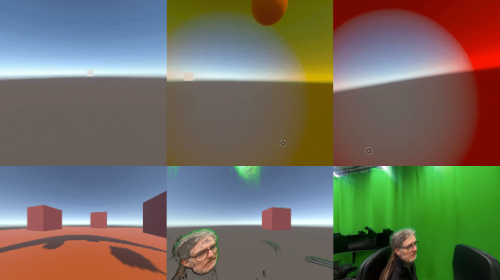
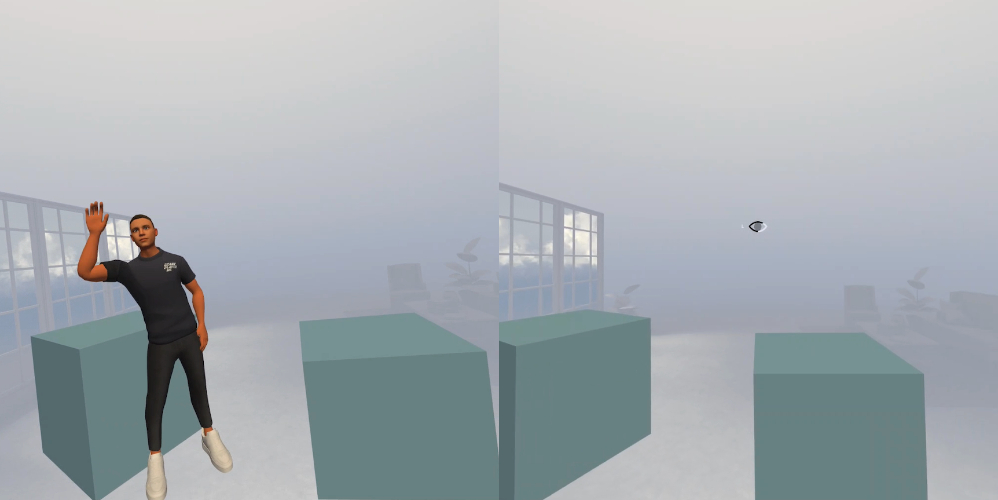
Bystander Awareness: To enhance social interaction and user comfort, I explored subtle notifications for situations in which someone nearby turns to look at the VR user. The scenario was simulated rather than detected automatically. Possible methods included:
- Avatar Fade: Displaying an avatar in the user’s peripheral vision, gradually decreasing in opacity as someone nearby turns their head towards the user.
- Gaze Indicator: Displaying a discreet visual cue, such as an eye icon, in the user’s vision to signal that someone is observing them.
Further exploration
- F-formation
- An F-formation consists of two or more people engaged in a joint activity. I explored how two remote VR users sitting on a train could be arranged in a shared collaborative space: face-to-face, side-by-side, corner-to-corner, or with a coupled view.